
Microplastic Detox: Can Zeolite Help Remove Heavy Metals, PFAS and Microplastics from the Body?
Article by NTA International www.ntawellness.com
Microplastics have moved from an environmental concern to a human-health question. Plastic particles have been detected in human blood and tissues, while researchers continue to investigate their potential effects on oxidative stress, inflammation, metabolism and immune function. At the same time, an expanding body of research demonstrates that clinoptilolite zeolite can adsorb heavy metals and other contaminants under controlled conditions. Can those properties be harnessed as part of a human detoxification strategy? Emerging evidence—including preliminary testing of a microscopic liquid zeolite formulation known as MasterPeace—suggests that the question deserves serious investigation.
For decades, detoxification in nutritional and environmental wellness has centered on familiar physiological systems: the liver, kidneys, gastrointestinal tract, lymphatic circulation, adequate hydration and nutrition.
Those systems remain fundamental.
What is changing is the environmental burden they are being asked to process.
Modern humans are exposed to a mixture of heavy metals, persistent industrial chemicals, plastic particles and other compounds through air, water, food, consumer products and occupational environments. Researchers are increasingly finding some of these materials inside the human body rather than merely in the external environment.
That makes environmental detoxification increasingly relevant to what NTA Wellness calls the cellular terrain: the biochemical environment in which cells must generate energy, maintain membranes, exchange minerals, communicate and repair themselves.
The objective is not simply to “stir up toxins.”
A more complete detoxification model is:
Reduce exposure → bind or sequester unwanted substances → support transport → prevent reabsorption → eliminate → restore the nutritional terrain.
Microplastics Have Been Detected in Human Blood
One important development has been the detection of plastic particles in human circulation.
A landmark 2022 human biomonitoring study reported measurable plastic-polymer components in blood, providing evidence that plastic particles can become bioavailable to the human bloodstream.
Source:
https://www.sciencedirect.com/science/article/pii/S0160412022001258
A subsequent 2024 study examined whole blood from 20 healthy volunteers and identified a wide range of microplastic polymer types and particle characteristics.
Source:
https://www.sciencedirect.com/science/article/pii/S0160412024003374
This does not mean that every detected particle necessarily produces disease. Human microplastic toxicology is still developing.
However, a 2024 systematic review concluded that available evidence supports concern about possible reproductive, digestive and respiratory effects, while emphasizing significant limitations and the need for better human research.
Source:
https://pubs.acs.org/doi/10.1021/acs.est.3c09524
Laboratory work has also shown that nanoplastics can interact directly with human blood cells and can produce polymer-dependent changes involving oxidative stress, cytokine release and hemolysis under experimental conditions.
Source:
https://www.sciencedirect.com/science/article/pii/S0048969724048745
The detoxification question therefore becomes increasingly reasonable:
If these materials can enter human circulation, what mechanisms can reduce exposure, prevent recirculation and facilitate their eventual elimination?
Explore Our Microplastics & PFAS Detox Research Hub
This article is part of a growing Watchman News / NTA Wellness research series examining microplastics, PFAS, environmental exposure, cellular burden, and practical detoxification strategies. For a broader overview and links to our related reports, see:
Microplastics in Your Brain: What the Emerging Research Means »
- Microplastics in the Brain: The Alarming Link Between Ultra-Processed Foods and Cognitive Decline
- Plastic-Eating Bacteria and Biofilm Infections: A Growing Threat Inside the Human Body
- The Truth About Microplastic Detox: It’s Not Just One Pill
Together, these reports examine the exposure problem, emerging biological concerns, and the broader NTA approach to reducing environmental burden rather than relying on any single intervention.
Why Zeolite Has Attracted Attention
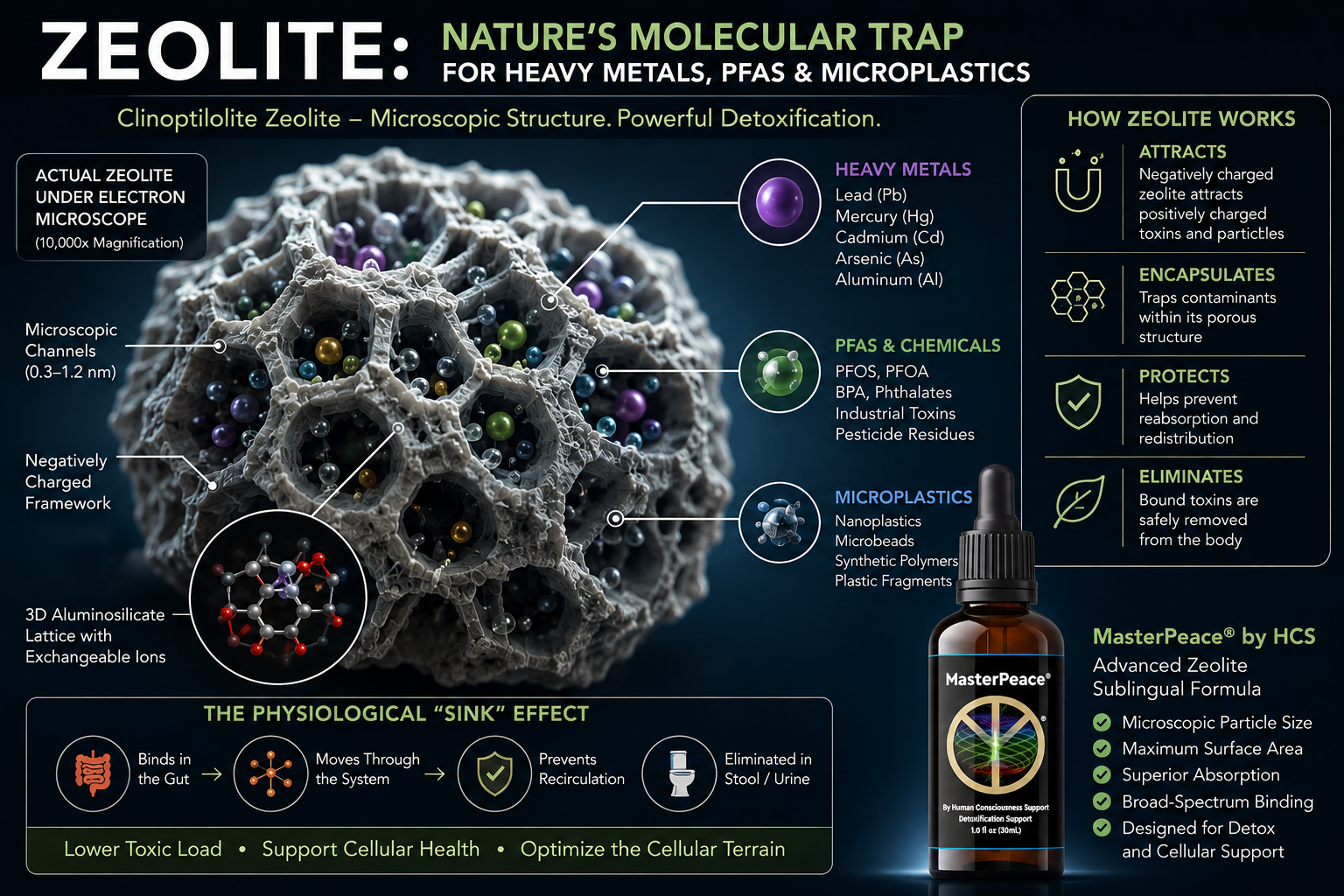
Clinoptilolite is a naturally occurring crystalline aluminosilicate belonging to the zeolite family.
Its unusual usefulness comes from a microscopic framework filled with channels, pores and exchangeable ions.
Zeolite is sometimes described commercially as a “magnet for toxins.”
That is useful imagery, but chemically it is more accurate to describe the process as adsorption and ion exchange.
Its negatively charged framework can attract and exchange particular positively charged ions according to factors including:
- ionic charge;
- hydrated radius;
- pore dimensions;
- surface chemistry;
- pH;
- concentration;
- and competition from other ions.
In other words, zeolite is not biologically deciding what is “good” or “bad.”
It possesses a physical and electrochemical architecture that gives it selective affinity for certain substances.
Heavy Metals: One of the Strongest Areas of Zeolite Research
This is where the broader literature becomes much stronger than the MasterPeace study alone.
A 2023 review in Chemosphere examined natural zeolites as adsorbents for metals including lead, cadmium, mercury, chromium, nickel and arsenic. The literature demonstrates that natural zeolites can possess substantial metal-binding capacity, although performance varies according to zeolite source, treatment and environmental conditions.
Source:
https://www.sciencedirect.com/science/article/pii/S0045653523007750
That research largely concerns environmental and aqueous remediation, so it should not be presented as direct proof that swallowing zeolite removes the same percentage of metal from human tissues.
But it demonstrates something fundamental:
The metal-binding chemistry itself is real.
And there is human evidence closer to the physiological question.
In a controlled human study using an isotopically labeled lead tracer, concomitant oral administration of purified clinoptilolite reduced gastrointestinal uptake of lead by approximately 90%, as demonstrated by lower tracer enrichment in both blood and urine.
Source:
https://pmc.ncbi.nlm.nih.gov/articles/PMC8292361/
That is an important result because it establishes a practical human mechanism:
clinoptilolite in the gastrointestinal tract can substantially reduce absorption of an undesirable metal.
This alone could potentially lower cumulative burden when exposure is ongoing.
Zeolite May Also Affect Metals Already Present in the Body
There are also experimental observations suggesting effects beyond blocking new absorption.
A 2017 animal study examined specially processed clinoptilolite in aluminum-intoxicated rats and reported reduced aluminum burden following administration.
Source:
https://www.sciencedirect.com/science/article/pii/S1387181117303116
A later long-term animal investigation found changes in the distribution of metallic elements between organs and blood following clinoptilolite administration. The investigators interpreted some of these changes as evidence of mobilization from tissue compartments.
Source:
https://pmc.ncbi.nlm.nih.gov/articles/PMC9952783/
Animal evidence cannot automatically be extrapolated to humans.
But these experiments introduce an important physiological concept.
There may be two distinct functions:
1. preventing additional absorption;
and potentially,
2. changing the equilibrium between stored, circulating and excreted contaminants.
That second possibility is especially relevant to the NTA detoxification model.

The NTA “Physiological Sink” Model
Consider the body as interconnected compartments:
Tissues ⇄ interstitial fluid ⇄ bloodstream ⇄ liver/kidneys ⇄ intestinal and urinary elimination
These compartments constantly exchange materials.
If a compound is removed efficiently from one compartment, equilibrium may gradually shift material from another compartment.
This is the concept of a physiological sink.
A binder does not necessarily have to physically enter every cell and pull contaminants directly from it.
For some substances, simply preventing intestinal reabsorption can alter whole-body kinetics.
The liver, for example, exports numerous substances through bile into the intestine.
Once there, some substances may be reabsorbed and returned to circulation.
Binding them within the intestinal lumen could theoretically favor:
biliary export → intestinal binding → fecal elimination
rather than:
biliary export → intestinal reabsorption → recirculation.
That is one reason good bowel function is not a trivial consideration in a detoxification program.
It is one of the principal routes through which the body actually completes elimination.
Could Zeolite Bind PFAS?
The PDF we reviewed cites an interesting 2024 study involving clinoptilolite and perfluoroalkyl substances.
Researchers modified clinoptilolite surfaces and demonstrated adsorption of perfluoroalkyl acids from aqueous media. They identified both hydrophobic and electrostatic interactions as contributors to the binding process.
Source:
https://link.springer.com/article/10.1007/s11356-024-32194-4
Again, this was water-remediation research, not a trial showing PFAS removal from human tissues.
That distinction should remain explicit.
But from a mechanistic standpoint it matters because PFAS compounds have historically been considered difficult targets precisely because of their unusual chemical stability.
Demonstrating that appropriately modified clinoptilolite surfaces can adsorb them provides a legitimate reason to investigate whether related binding interactions could have biological applications.
What About Microplastics?
This is perhaps the most interesting frontier.
The 2025 paper we reviewed describes MasterPeace as targeting microplastics and other environmental contaminants.
Source:
https://actascientific.com/ASMS/pdf/ASMS-09-1985.pdf
But there is also research entirely separate from MasterPeace showing that zeolite-based materials can participate in microplastic removal.
A 2024 review in Environmental Science and Pollution Research evaluated zeolite-based nanocomposites for removing microplastics, metals, ammonia and other contaminants from wastewater.
Across the materials surveyed, reported adsorption efficiencies for various contaminants could range from approximately 81% to greater than 99%, depending upon the particular zeolite composite, pollutant and experimental conditions.
Source:
https://link.springer.com/article/10.1007/s11356-023-31185-1
This does not mean that a person taking zeolite eliminates 81–99% of the microplastics in his or her body.
The research concerns environmental remediation.
But it answers a different foundational question:
Can zeolite-based porous materials physically capture plastic contaminants?
The answer appears to be yes, under appropriate conditions.
That lends some physical plausibility to the MasterPeace hypothesis, while leaving the biological pharmacokinetic question open.
NTA Featured Complete Zeolite Formula: MasterPeace
For readers looking to put the zeolite principles discussed here into practice, NTA Wellness currently features MasterPeace by Human Consciousness Support as our go-to advanced all-in-one formulation, combining microscopic clinoptilolite zeolite with sea mineral plasma in a concentrated sublingual product.
Learn More or Order MasterPeace »
Affiliate disclosure: NTA Wellness may receive a commission from qualifying purchases made through this link, at no additional cost to you.
This Distinction Strengthens Rather Than Weakens the Case
There are now several layers of evidence:
Layer 1 — Established material chemistry
Clinoptilolite possesses adsorption and ion-exchange properties capable of binding numerous metals and other contaminants.
https://www.sciencedirect.com/science/article/pii/S0045653523007750
Layer 2 — Environmental microplastic and PFAS research
Zeolite-based materials can adsorb microplastics and certain PFAS compounds in aqueous systems.
https://link.springer.com/article/10.1007/s11356-023-31185-1
https://link.springer.com/article/10.1007/s11356-024-32194-4
Layer 3 — Animal biological research
Experimental clinoptilolite administration has altered aluminum and other metal burdens in animal models.
https://www.sciencedirect.com/science/article/pii/S1387181117303116
https://pmc.ncbi.nlm.nih.gov/articles/PMC9952783/
Layer 4 — Human gastrointestinal evidence
Purified clinoptilolite substantially reduced absorption of an isotopically tracked lead dose in human volunteers.
https://pmc.ncbi.nlm.nih.gov/articles/PMC8292361/
Layer 5 — Preliminary MasterPeace human observations
Small product-specific pilot testing has reported changes in measured environmental contaminants over several weeks of administration.
https://actascientific.com/ASMS/ASMS-08-1913.php
That sequence is much more persuasive than relying on the MasterPeace pilot study alone.
It says:
The underlying chemistry is established. Several relevant biological mechanisms have experimental support. Human evidence exists for at least some metal-binding applications. Product-specific evidence is now emerging for broader environmental contaminants.
That is a scientifically defensible progression.
What Is Different About MasterPeace?
MasterPeace combines microscopic clinoptilolite with a sea-mineral colloidal solution.
The product developers propose that its unusually small zeolite structures increase available surface area and allow broader interaction with bodily fluids.
The paper provided for our review includes high-resolution transmission electron microscopy imagery of the MasterPeace zeolite matrix and describes a porous, negatively charged microscopic structure.
Source:
https://actascientific.com/ASMS/pdf/ASMS-09-1985.pdf
From an NTA standpoint, the mineral component is also interesting.
An ideal detoxification program should not simply remove substances.
It should maintain the ionic environment required for:
- mitochondrial enzymes;
- electrolyte regulation;
- membrane potentials;
- nerve transmission;
- muscular function;
- and cellular repair.
This is one reason the NTA protocols emphasize remineralization alongside detoxification rather than aggressive depletion.
What Has the MasterPeace Pilot Study Reported?
The earlier MasterPeace pilot study involved only three adult participants, making it exploratory rather than definitive clinical evidence.
Source:
https://actascientific.com/ASMS/ASMS-08-1913.php
Participants were evaluated at baseline and again during approximately 90 days of supplementation.
The investigators reported declines in measurements associated with several environmental contaminants, including:
- polyethylene;
- polypropylene;
- PFOS;
- PFOA;
- selected heavy metals;
- and other substances.
The Redacted interview with study investigator Caroline Mansfield similarly describes participants beginning with elevated measured levels of polyethylene, polypropylene, PFOS and PFOA and experiencing reductions during the observation period.
Separate hair and urine testing was also incorporated to evaluate heavy metals.
These findings are intriguing.
They are not equivalent to a large randomized clinical trial, and the testing methods require independent replication.
But as exploratory evidence, they justify further investigation—particularly because they sit upon a much broader literature demonstrating that zeolite materials really do bind several of the classes of substances being targeted.
The Question of Systemic Absorption
One question remains particularly important.
Conventional clinoptilolite is generally thought to act primarily within the gastrointestinal tract.
MasterPeace proposes that its microscopic colloidal formulation can interact more systemically after sublingual administration.
If so, future studies should establish:
absorption → biodistribution → contaminant binding → transport → excretion.
It is not sufficient merely to demonstrate lower blood concentrations.
Researchers ultimately need to know where both the contaminant and the zeolite carrier go.
This is especially important for nanoparticle-sized materials.
For NTA, this remains one of the principal unanswered research questions surrounding microscopic zeolite formulations.
Does Zeolite Remove Beneficial Minerals?
Zeolite is chemically selective, but it is not intelligent.
Its interactions depend upon ionic properties rather than whether an element is biologically useful.
For that reason, mineral balance should be monitored in prolonged or intensive detoxification programs.
However, existing clinoptilolite research does not support the idea that normal use automatically strips the body of all essential minerals.
The intestinal environment contains large concentrations of sodium, potassium, calcium, magnesium and other competing ions, while different metals have different affinities for zeolite exchange sites.
The sensible NTA position is therefore neither:
“Zeolite only touches toxins,”
nor:
“Zeolite indiscriminately removes every mineral.”
The chemistry is more selective and more complicated than either claim.
Why Beginning Slowly Makes Sense
MasterPeace researchers have advised particularly sensitive individuals to begin at low doses and gradually increase intake.
In the interview, Mansfield describes lowering sensitive participants to approximately one drop twice daily and titrating upward rather than beginning aggressively.
That approach makes physiological sense independent of any particular “detox reaction” theory.
An optimal program should maintain the relationship:
mobilization ≤ binding ≤ elimination capacity.
Faster is not automatically better.
Hydration, bowel regularity, liver function, kidney function, mineral status, nutritional status and individual sensitivity all influence tolerance.
Headaches, fatigue, loose stool or other symptoms should also not automatically be interpreted as evidence that “toxins are leaving.”
Symptoms are information, not proof of detoxification.
Detoxification Is a System, Not a Bottle
At NTA Wellness, our environmental detoxification protocols therefore begin with the larger biological picture.
Reduce exposure.
Improve drinking water, limit unnecessary plastic food contact, reduce avoidable sources of metals and persistent chemicals, and consider indoor air and occupational exposure.
Maintain intestinal elimination.
Regular bowel movements support one of the body’s principal pathways for eliminating biliary waste and reducing recirculation.
Support hydration and mineral balance.
Normal circulation, renal clearance and cellular electrical function require adequate water and electrolytes.
Support liver and bile physiology nutritionally.
Support lymphatic movement and physical activity.
Use binders intelligently.
And finally:
rebuild the cellular terrain.
The objective is not simply to produce an impressive laboratory number.
It is to reduce unnecessary biological burden so normal metabolism has a better environment in which to function.
This returns to one of our central NTA principles:
To “heal thyself” is to “heal thy cell.”
Our Current Assessment of MasterPeace Zeolite
MasterPeace is one of the more interesting emerging environmental-wellness products we have examined.
The strongest case for investigating it does not rest upon any single extraordinary claim.
It rests upon the convergence of several more ordinary—but scientifically meaningful—observations:
Clinoptilolite demonstrably binds toxic metals.
Human research demonstrates that oral clinoptilolite can sharply reduce absorption of lead.
https://pmc.ncbi.nlm.nih.gov/articles/PMC8292361/
Animal research suggests some preparations can influence previously accumulated metal burdens.
https://www.sciencedirect.com/science/article/pii/S1387181117303116
https://pmc.ncbi.nlm.nih.gov/articles/PMC9952783/
Zeolite-based materials can capture microplastic contaminants under experimental conditions.
https://link.springer.com/article/10.1007/s11356-023-31185-1
Modified clinoptilolite can adsorb PFAS compounds in aqueous systems.
https://link.springer.com/article/10.1007/s11356-024-32194-4
And preliminary MasterPeace human observations report changes in several of the same categories of environmental contaminants.
https://actascientific.com/ASMS/ASMS-08-1913.php
The next scientific step should be larger independently controlled human studies using validated microplastic and PFAS analytical methods, together with direct pharmacokinetic measurements of the microscopic zeolite itself.
Until then, we regard MasterPeace not as a substitute for healthy nutrition or normal elimination—but as a promising tool within a comprehensive environmental detoxification strategy.
NTA Wellness Research Note
NTA Wellness reviews both established and emerging research in environmental wellness, nutrition and cellular physiology. Emerging findings are identified as such. This material is educational and is not intended to diagnose, treat, cure or prevent disease. Individuals with significant renal or hepatic impairment, pregnancy, complex medical conditions or prescription medication use should consult an appropriately qualified healthcare professional before beginning an intensive supplementation program.
Continue the Watchman News Microplastics & PFAS Series
If you are researching environmental burden and detoxification, continue with these companion reports:
Microplastics in the Brain »
Plastic-Eating Bacteria & Biofilm Infections »
The Truth About Microplastic Detox »
Microplastics / PFAS Research Hub »
Selected Research
Leonard SVL, et al. Microplastics in human blood: Polymer types, concentrations and characterisation using μFTIR. Environment International. 2024.
https://www.sciencedirect.com/science/article/pii/S0160412024003374
Leslie HA, et al. Discovery and quantification of plastic particle pollution in human blood. Environment International. 2022.
https://www.sciencedirect.com/science/article/pii/S0160412022001258
Chartres N, et al. Effects of Microplastic Exposure on Human Digestive, Reproductive, and Respiratory Health: A Rapid Systematic Review. Environmental Science & Technology. 2024.
https://pubs.acs.org/doi/10.1021/acs.est.3c09524
Velarde L, et al. Adsorption of heavy metals on natural zeolites: A review. Chemosphere. 2023;328:138508.
https://www.sciencedirect.com/science/article/pii/S0045653523007750
Samekova K, et al. Concomitant oral intake of purified clinoptilolite tuff reduces enteral lead uptake in healthy humans. Scientific Reports. 2021.
https://pmc.ncbi.nlm.nih.gov/articles/PMC8292361/
Kraljević Pavelić S, et al. Novel, oxygenated clinoptilolite material efficiently removes aluminium from aluminium chloride-intoxicated rats in vivo. Microporous and Mesoporous Materials. 2017.
https://www.sciencedirect.com/science/article/pii/S1387181117303116
Long-term clinoptilolite investigation of metallic-element distribution in biological tissues.
https://pmc.ncbi.nlm.nih.gov/articles/PMC9952783/
Hedayati MS, et al. Removal of perfluoroalkyl acids from aqueous media by surfactant-modified clinoptilolites. Environmental Science and Pollution Research. 2024;31:16915–16927.
https://link.springer.com/article/10.1007/s11356-024-32194-4
Munir N, et al. The potential of zeolite nanocomposites in removing microplastics, ammonia, and trace metals from wastewater and their role in phytoremediation. Environmental Science and Pollution Research. 2024;31:1695–1718.
https://link.springer.com/article/10.1007/s11356-023-31185-1
Young RO. MasterPeace Zeolite Z Pilot Study Found to be Safe and Effective in Removing Nano and Micro Toxic Forever Chemicals, Heavy Metals, Micro Plastics and Graphene and Aluminum Found in the Human Body Cells and Fluids. Acta Scientific Medical Sciences. 2024;8(9):111–117.
https://actascientific.com/ASMS/ASMS-08-1913.php
Young RO. The Therapeutic Potential of Cannabidiol Oil and Zeolite Z in an aqueous colloidal solution of SOLergy Sea Minerals. Acta Scientific Medical Sciences. 2025;9(1):18–24. For our purposes, this paper is principally useful for its zeolite discussion, microscopy and bibliography rather than its cannabinoid or cancer-treatment propositions.
https://actascientific.com/ASMS/pdf/ASMS-09-1985.pdf